
Understanding Market Crash Indicators: Read the Crowd Before It Runs for the Exit
September 13, 2026
Markets rarely crash because somebody suddenly discovers that stocks are expensive. The conditions for a crash usually build much earlier, when valuation stretches, leverage expands, liquidity becomes complacent, and investors gradually become convinced that whatever has been working will continue working indefinitely. The real warning is therefore not one isolated indicator but the convergence of several forces, because a market becomes fragile when too many participants are positioned for the same outcome and too few are prepared for the opposite.
The 2021 market provides an excellent case study because the warning signs were visible long before the subsequent tightening cycle exposed them. The S&P 500 gained roughly 26% that year, speculative activity exploded, meme stocks became cultural phenomena, cryptocurrencies reached extraordinary valuations, and investors increasingly treated liquidity as though it were a permanent feature of the financial system. The lesson was not that a crash had to occur immediately, because markets can remain irrational for much longer than expected, but that the psychological foundation supporting prices was becoming increasingly dependent on confidence, liquidity and the willingness of the crowd to keep paying higher prices.
The Everything Bubble: When Valuation Stops Restraining Behaviour
One of the most obvious market crash indicators is valuation, although valuation by itself is a poor timing mechanism. In September 2026, the Shiller CAPE ratio is around 41, compared with its historical mean near 17.4 and a peak of 44.2 in December 1999, placing current valuations firmly in historically expensive territory. The conventional S&P 500 P/E ratio is also around 26, which means investors are still paying a substantial premium for future earnings even though interest rates are nowhere near the emergency levels that supported the post-2020 valuation expansion.
That does not mean a crash is imminent, and this distinction matters because expensive markets can remain expensive while earnings grow and liquidity continues to support risk assets. What valuation tells us is how much optimism is already embedded in the price, which becomes increasingly important when the market encounters a shock that challenges the assumptions supporting those prices. The more confidence investors have that growth, margins, liquidity and technological progress will continue without interruption, the greater the psychological adjustment when one of those assumptions begins to fail.
Meme Stocks Revealed the Psychology Beneath the Surface
The GameStop episode in 2021 was important not because meme stocks caused the broader market decline that followed, but because it exposed how quickly speculation could become social identity. GameStop, AMC and other heavily shorted stocks became symbols of rebellion, and the investment decision increasingly became secondary to participation in a collective narrative. The market was demonstrating something more important than simple irrationality: once financial decisions become connected to identity, community and emotional gratification, traditional valuation arguments can lose their ability to influence behaviour.
That psychological mechanism has not disappeared. It has simply migrated into different areas of the market, particularly artificial intelligence, speculative technology, cryptocurrencies and other narratives where enormous future possibilities can justify increasingly aggressive present valuations. The indicator to watch is therefore not merely whether an asset is expensive, but whether investors have started treating criticism of the asset as criticism of themselves.
Leverage Is Where Confidence Becomes Fragile
Leverage is one of the most important crash indicators because borrowed money transforms declining prices into forced decisions. When investors purchase securities with borrowed capital, falling prices can create margin pressure, which produces additional selling, which pushes prices lower, which creates still more pressure, turning an ordinary correction into a self-reinforcing liquidation.
The current data are particularly interesting because leverage remains historically elevated even after a sharp July contraction. FINRA margin debt stood at approximately $1.417 trillion in July 2026, down 5.6% from the record $1.502 trillion recorded in June, but still 38.6% above the level of July 2025. July’s decline was the largest dollar monthly drop in the series, yet the reduction followed the two largest monthly increases on record in May and June, making the sequence more informative than the isolated July number.
This is precisely why leverage should not be treated as a simple sell signal. A decline in margin debt can represent healthy deleveraging rather than impending disaster, while a rapid increase can reveal growing speculation without telling you exactly when the market will turn. The important question is whether leverage is expanding alongside euphoric positioning and weakening market breadth, because that combination creates a much more unstable structure than leverage alone.
The Federal Reserve Effect: Liquidity Can Change Behaviour
The post-pandemic market demonstrated how monetary policy can alter investor psychology far beyond the mechanical effect of interest rates. Near-zero rates, enormous fiscal transfers and extraordinary liquidity encouraged investors to move further out along the risk curve, while the rapid recovery in asset prices reinforced the belief that buying weakness would eventually be rewarded.
The environment is very different today, although the psychological legacy remains relevant. The effective federal funds rate was 3.63% on September 10, 2026, while the 10-year Treasury yield was around 4.93% after briefly approaching 5%, meaning investors are operating in a considerably less forgiving interest-rate environment than they were in 2020 and 2021.
This matters because high valuations become more vulnerable when safer assets offer meaningful yields and the discount rate rises. The market does not need a monetary collapse to experience a psychological reversal; it only needs investors to conclude that the future earnings growth they previously considered almost certain is no longer sufficient to justify the price they are paying today.
The New Speculative Frontier Is AI
The speculative psychology of 2021 has not disappeared. It has evolved.
Artificial intelligence is producing genuine technological and economic transformation, which makes the present environment fundamentally different from a market built entirely around companies with no earnings or viable business models. Yet genuine technology does not make every valuation rational, and the amount of capital flowing into AI infrastructure means investors must increasingly distinguish between a powerful technological trend and the prices being paid for exposure to it.
That distinction is becoming more important because AI-related debt issuance reached nearly $500 billion by early August 2026, according to Reuters, while major technology companies have been issuing substantial amounts of debt to finance data-center expansion. At the same time, lenders have become more cautious as electricity constraints, project delays and financing requirements increase.
This is a classic late-cycle question: Is the underlying development strengthening, or is the financial structure supporting it becoming increasingly dependent on optimistic assumptions? The technology can be real while the trade becomes crowded, and that is precisely where mass psychology becomes more important than the underlying narrative.
Why the Crash Waits
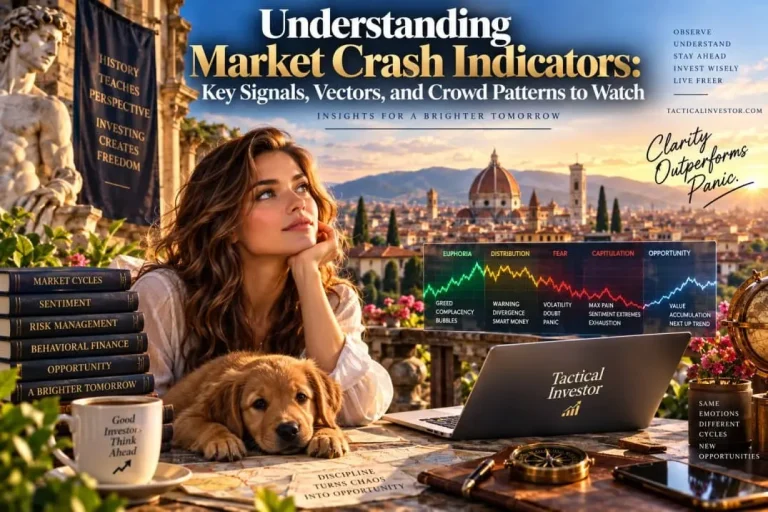
Markets do not crash simply because the indicators become extreme. They crash when the dominant psychological force changes. That is why expensive markets can continue rising despite obvious warnings. When everybody believes the trend will continue, the investor who becomes cautious too early appears irrational, and the longer the market rises after every warning, the more confidence becomes attached to the belief that the warnings were wrong. Eventually, however, the crowd reaches saturation, and what previously required little effort to push prices higher begins requiring increasingly greater amounts of capital and increasingly stronger narratives.
This is where the concept of market direction becomes more useful than a rigid crash prediction. You want to know whether the dominant force is expanding, weakening, broadening or becoming exhausted, because the transition from strong upward momentum to unstable upward momentum is often visible before the actual reversal.
Today’s Market Is Not 2021, and That Matters
As of the September 11 close, the S&P 500 stood at 7,656.98, still up about 11.9% for the year despite a 0.8% weekly decline. The Nasdaq was up about 13.3% YTD, while the Russell 2000 remained up roughly 17%, demonstrating that the market has not entered a broad panic even though higher oil prices, rising Treasury yields and inflation concerns have produced greater volatility.
Investor sentiment has also changed considerably from the extreme optimism associated with the speculative phase of 2021. The latest AAII survey, for the week ending September 9, showed 38.0% bullish, 22.7% neutral and 39.3% bearish, producing a slightly negative bull-bear spread rather than the kind of overwhelming optimism normally associated with a classic speculative peak.
That distinction is critical because a market with expensive valuations but increasingly cautious sentiment is psychologically different from a market with expensive valuations and extreme euphoria. The current environment therefore contains warning signs, but it does not yet provide the simple psychological profile of a fully mature bubble top, which means the intelligent investor should be watching for deterioration in breadth, credit, earnings expectations, liquidity and price behaviour rather than declaring a crash simply because valuation is high.
The Reaction Is More Important Than the Indicator
A market crash indicator becomes far more useful when you observe how investors respond to information that should matter. If bad news produces a temporary decline followed by aggressive buying, the underlying demand remains strong, whereas increasingly good news produces smaller rallies and increasingly bad news produces larger declines, the market is telling you that the dominant force is losing strength.
This is why technical analysis matters alongside valuation and sentiment. RSI, moving averages, volume, breadth, volatility and momentum do not predict the future with certainty, but they reveal how the market is responding to the forces acting upon it. Fundamentals tell you what should matter, psychology tells you what the crowd believes, and price behaviour tells you what the crowd is actually doing. The most dangerous environment is therefore not necessarily maximum fear. It is maximum certainty.
The Tactical Investor’s Edge: Prepare Before the Crowd Understands
The objective is not to predict the exact day of the next crash. That obsession usually produces either premature bearishness or emotional capitulation after the market has already fallen, neither of which creates a durable advantage.
The better approach is to monitor the convergence of valuation, leverage, sentiment, liquidity, breadth, interest rates and price behaviour, then determine whether those forces are reinforcing the existing trend or beginning to fight against it. When the crowd is euphoric, reduce the assumption that prices must continue rising; when fear becomes extreme, stop assuming that falling prices automatically mean greater risk and start asking whether quality assets are being liquidated indiscriminately.
Cash and liquidity become particularly valuable in these environments because optionality has a different value when everybody else is being forced to make decisions. For investors who genuinely want to own specific stocks at lower prices, cash-secured puts can also turn waiting into an active strategy by allowing you to get paid to wait for the price you actually want rather than simply sitting on an unproductive limit order.
The Crowd Sees the Crash. The Prepared Investor Sees the Opportunity
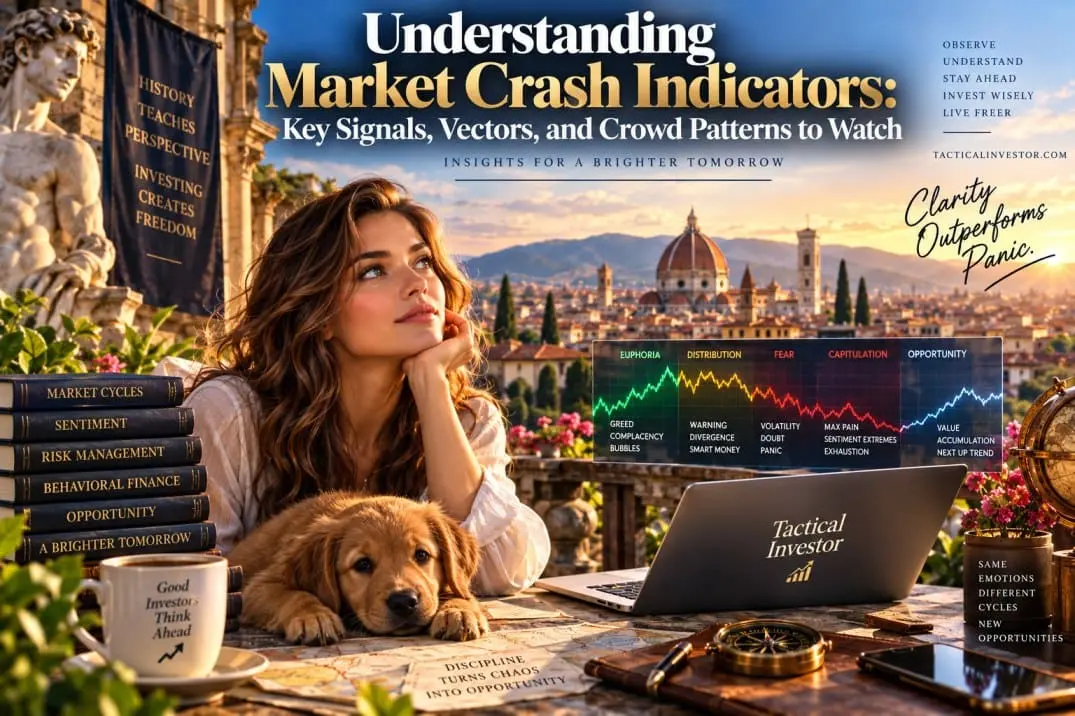
Every major market decline eventually creates two different experiences. One group experiences the collapse as confirmation that the financial system is broken, while another group studies the same collapse for evidence that selling pressure is becoming exhausted and quality assets are being offered at increasingly irrational prices.
That does not mean every crash creates an automatic buying opportunity, because broken companies can remain broken and excessive valuations can remain excessive for years. The opportunity appears when mass psychology becomes so extreme that price begins to disconnect materially from reasonable value, while the investor has the liquidity, patience and discipline to act without being forced into the crowd’s emotional timetable.
The indicators are therefore not really about predicting crashes. They are about understanding when confidence has become excessive, leverage has become dangerous, expectations have become unrealistic and the market’s dominant psychological force is beginning to lose power. By the time the crowd finally recognizes the crash, the important work should already have been done, because the investor who understands the psychology does not need to run for the exit with everyone else.
The next bubble will come because human nature has not changed. The next crash will come because leverage, valuation and psychology eventually collide, and the next opportunity will emerge because fear can push prices further away from value than greed ever thought possible.